The CES Wraps Up Sustainability Month with a Big Green Bow!
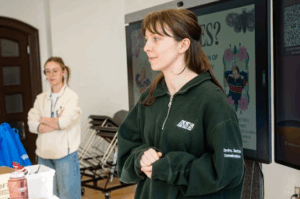
Eco-Trivia Night
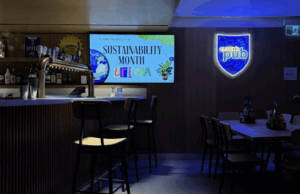
Getting Trivial With It: Topics and Difficulty
The CES team provided our community with great questions that not only appeal to lovers of the environment, but also to everyone in the audience with vested interests in other areas, such as pop culture or movies and film.
They also included topics such as nature and Queen’s University, which is a must for Eco-Trivia night! The CES team did an amazing job shaping the questions, keeping the audience on their toes at all times! As an Environmental Science major and someone who is passionate about sustainability, this was naturally an event of interest to me. I fully expected the questions to be solely environmental science based, walking in with 100% confidence that I’d nail every answer, but I was faced with more of a challenge than I thought! I ended the night with only getting about 5 questions right out of 40 (oops), but that goes to show that the questions weren’t created for just environmental science brainiacs, but for people that are knowledgeable in a range of niche topics (so not me)!
Overall Vibes Of The Night
 If I had to use three words to describe the vibes of Eco-Trivia night, they would be exciting, collaborative, and energetic. With multiple groups participating in the trivia and many full tables, I’d say there was a great turnout for the event! I absolutely loved the vibes of the night and getting to see so many members of our community laughing, working together, and just having an amazing time.
Indigenous Nature Walk & Talk: Listening to the Belle Island
Shiv Parekh, ArtSci ’26, is thrilled to tell you about his experience at the Indigenous Nature Walk & Talk:
I didn’t realize how much I needed the Indigenous Nature Walk at Belle Island until I stepped off the bus and felt everything slow down. We met outside Stauffer Library, a mix of familiar faces and strangers, all half-awake and clutching coffee. By the time we arrived at Belle Island, the energy had shifted. The space felt calm, intentional, and different from the usual campus rush.
 Throughout the walk, our guide shared Indigenous teachings about land, water, and responsibility that grounded the place in a much deeper history than I’d ever considered. Instead of treating the island like a scenic backdrop, we were asked to see it as a living relative, deserving of respect and care. Hearing about treaties, traditional knowledge, and the spiritual connection to this land made me realize how surface-level my understanding had been before.
There were long, quiet moments too—just listening to the wind and water, the crunch of leaves, and our own footsteps. Those pauses made it easier to breathe, to reset, and actually to absorb what we were hearing. It felt less like an event and more like being invited into a relationship: with the land, with each other, and with Indigenous perspectives that should have been centered all along.
By the time we headed back to campus, I felt lighter but also more accountable. The walk was peaceful and restorative, but it was also a reminder that learning about Indigenous ways of knowing cannot start and end with one afternoon. It made me want to pay closer attention to the spaces I move through every day, and to the voices that have been caring for them long before we arrived.
Citizen Science Workshop: Small Actions, Real Impact
Parekh also attended the Citizen Science Workshop, and he is so excited to dive in on his experience!
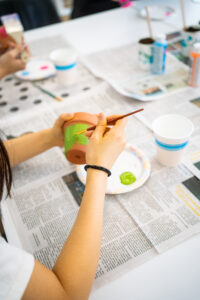

When I walked into the Citizen Science workshop, I expected a simple craft table and maybe a short talk about apps. Instead, it felt like being let in on a set of tools that make paying attention to the planet actually matter. The space was set up with paint, pots, soil, and native plant seedlings!
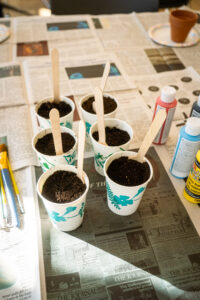
People from the AMS Commission of Environmental Sustainability and the Society for Conservation Biology were there to welcome us and explain what the afternoon was about. They broke down citizen science in a way that felt very straightforward. Every day, people can help monitor biodiversity and environmental change just by recording what they see and hear, and that data is actually used by researchers and conservation projects.
We rotated between stations, and each one made the idea more real. At the iNaturalist table, we learned how to upload photos and observations so they can be verified and added to global biodiversity databases. Merlin showed us how to identify birds through sound and photos, turning every walk outside into a chance to contribute to migration and distribution research. The Adopt A Pond information highlighted how frogs and turtles are indicators of wetland health, and how simple observations can support protection efforts.
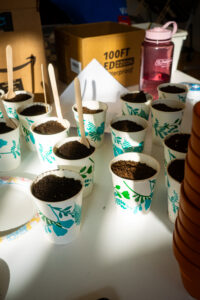
Between all of that, there was something really grounding about painting a pot, filling it with soil, and planting native species like prairie smoke, harebells, milkweed, and bee balm to take home. It was creative, a bit messy, and quietly powerful. Someone explained how these plants support pollinators and local ecosystems, and suddenly this little pot on the table felt like a promise to pay more attention.
What I liked most was that the workshop never made climate and conservation feel abstract or hopeless. It showed us that noticing a bird, logging a turtle, or planting something native are all small, real contributions. I left with dirt under my nails, a painted pot in my hands, and a better sense that being a student does not limit my ability to help. It actually gives me more chances to look up, record, and care.
For any questions, concerns, or media inquiries, please contact the Communications Office, at . We’re here to help.