Indigenous Spaces: A Campus Highlight
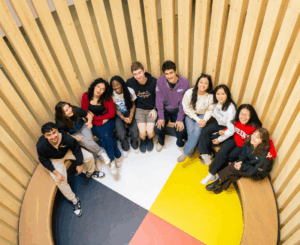
If you’ve spent any time walking around Queen’s campus, you’ve probably noticed a few spaces that look and feel a little different, whether it’s a circle of benches, a room filled with Indigenous artwork, or even the Seven Grandfather Teachings Stairs in the JDUC.
These aren’t just fun design choices! They’re intentional. They are spaces that honour the fact that Queen’s is situated on the traditional lands of the Haudenosaunee and Anishinaabek peoples. They’re meant to be places of gathering, reflection, and learning, and they remind us of the importance of reconciliation and respect in our campus community.
Here are some of the Indigenous spaces you can explore at Queen’s:
- Indigenous Seating Circle (“The Turtle – Our Mother Earth; The Teachings of the Good Mind”) The Turtle shell represents our Mother Earth, the benches represent our oldest ancestors, the Two Row Wampum Treaty belts that wrap around them represent the Haudenosaunee way of life. This gathering space is representative of the respect we have for one another in all of our differences, and that we do not impose our laws, cultures, and ways on each other: Located in the Endaayaan-Tkanónsote residence courtyard.
- Indigenous Past and Futures at Queen’s, a plinth honouring the Indigenous Peoples: Located on McGibbon Walk between Douglas Library and Ontario Hall
- ASUS Reflection Room, in acknowledgment of the historical and continuing impacts of colonization in Canada on the Indigenous staff, students, and community at Queen’s: Kingston Hall, room 213
- Aboriginal Teacher’s Education Program Lounge: Duncan McArthur Hall room A246
- Fireplace Room: Queen’s Centre, 2nd floor
- The Fireplace Room on the second floor of the Queen’s Centre was created as a dedicated Indigenous space on campus, reflecting Queen’s University’s commitment to reconciliation, inclusivity, and cultural representation.
- Its purpose is to provide a welcoming environment where Indigenous students can feel a sense of belonging and cultural safety, while also serving as a place for the broader community to learn about and engage with Indigenous traditions.
- The room’s design itself carries symbolic meaning: features such as the fireplace, Indigenous artwork, and a large dream catcher create an atmosphere of warmth and gathering, while also embodying Indigenous aesthetics and traditions. In this way, the space is not only a place to study or relax but also a visible acknowledgment of Indigenous culture, belonging, and continuity within the Queen’s community.
- Four Directions Indigenous Student Centre: 146 and 148 Barrie St.
- Indigenous Themed Study Rooms, 12 new study rooms given Indigenous names and artwork to increase the visibility of the Indigenous community: Joseph S. Stauffer Library
- InEng Student Room, a study room for Indigenous engineering students to gather: Beamish-Munro Hall, room 322
- Kanonhweratónhtshera G’di-mikwanim The Welcoming Room, a communal gathering space and Indigenous classroom: Mackintosh-Corry Hall, room E202
- Mother and Child, two soapstone carvings that represent the Inuit family unit and parental bond: Faculty of Medicine Building, main foyer
- Office of Indigenous Initiatives: Richardson Hall, room 353
- Outdoor Indigenous Gathering Space, with design inspiration found in traditional Anishinaabe wigwams: Located between Tindall Field and Mackintosh-Corry Hall
- Sacred Medicine Garden: Located behind Duncan McArthur Hall
- Staff/Student Learning Centre: Joseph S. Stauffer Library, room 14
- Seven Grandfather Teachings Stairs: Located in the Agora, 2nd floor of the John Deutsch University Centre
Navigation Struggles? Use The Campus Map!
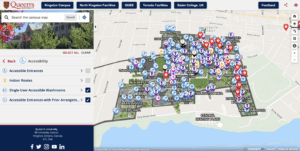
Navigating your campus has never been so easy! Our Queen’s interactive campus map allows you to pinpoint exactly what you’re looking to find with a legend of locations including buildings, academics, amenities and more! Each feature listed in the blog can be easily located on our campus map, which can be found on the Queen’s University website or by clicking the link!
If you have any questions about the above information, you can contact our Human Rights and Equity Office by email hreo@queensu.ca, or you can drop by their office, located in Mackintosh-Corry Hall room B506.
For any questions, concerns, or media inquiries, please contact the Communications Office, at . We’re here to help.